

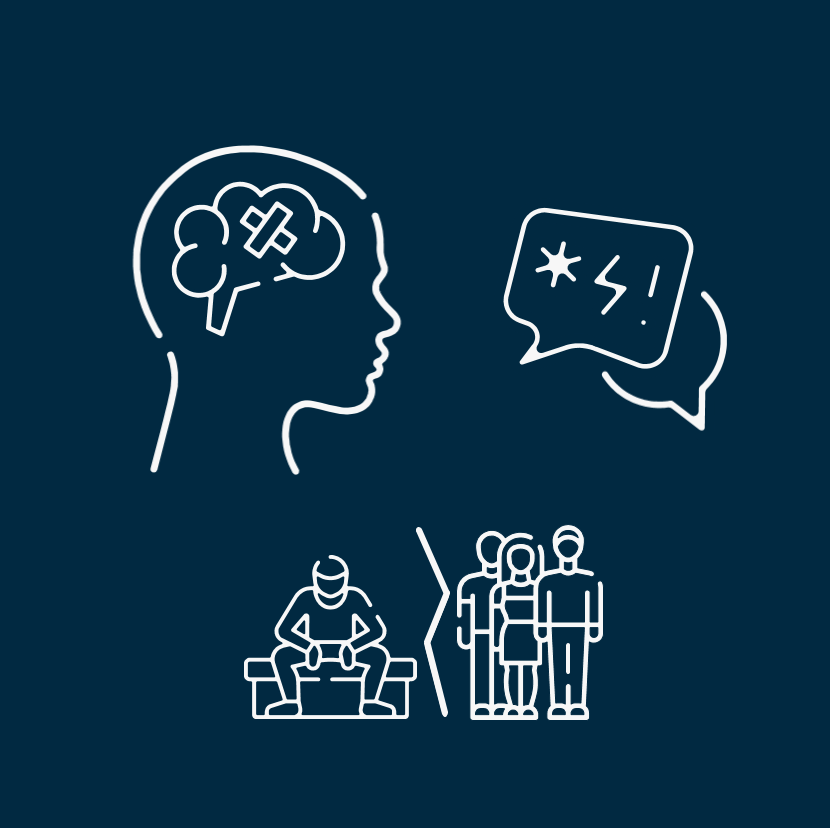
Domestic violence
In every relationship, moments of anger and frustration can occur. However, these episodes should remain occasional and must not turn into a repetitive cycle where one partner dominates the other. When such behaviors become frequent and part of the relationship dynamic, it is considered domestic violence.
Intimate Partner and Family Violence in Indigenous Contexts
Among Indigenous peoples, intimate partner and family violence cannot be understood without considering the historical context. Colonialism and related policies, such as residential schools and the Indian Act, explicitly aimed to dismantle families and communities. These intergenerational traumas weakened family bonds and contributed to cycles of violence that persist to this day.
Breaking this cycle means acknowledging these realities, supporting survivors, and promoting culturally safe approaches that foster healing at the individual, family, and community levels.
- 43% of First Nations women have experienced physical or sexual violence by an intimate partner at some point in their lives.¹
- Indigenous women face a higher risk of experiencing intimate partner violence and endure more severe forms of violence than non-Indigenous women.²
- Indigenous women are overrepresented as victims of various forms of violence.³
- The presence of multiple adverse factors operating within a specific social and historical context helps explain the high prevalence of intimate partner violence in Indigenous communities.
The presence of multiple adverse factors operating within a specific social and historical context helps explain the high prevalence of intimate partner violence in Indigenous communities.4
Recognizing domestic violence
Physical abuse
– Hitting and pushing
– Burning and biting
– Physical restraint
Psychological abuse
– Putting others down
– Dismissive attitudes and offensive remarks
– Implicit or explicit blackmailing and threatening
Verbal abuse
– Sarcasm and insults
– Shouting
– Demeaning and humiliating remarks
Economic abuse
– Withholding or controlling financial or material resources (for example, controlling the budget or demanding the other to justify their spending)
– Creating financial dependency
Social abuse
– Denigrating the victim’s loved ones
– Forbidding contact of visits with family and friends
– Controlling emails and phone calls
Looking for more information? Check out our video series:
Sources
- Statistics Canada. (2018). Survey of Safety in Public and Private Spaces (SSPPS).
- Institut national de santé publique du Québec. Contexte de vulnérabilité : femmes autochtones. INSPQ.
- Burczycka, M., Conroy, S., & Savage, L. (2018). Family violence in Canada: A statistical profile, 2017. Canadian Centre for Justice Statistics. Statistics Canada. ; Burczycka, M., & Conroy, S. (2018). Family violence in Canada: A statistical profile, 2016. Canadian Centre for Justice Statistics. Statistics Canada. Cotter, A. (2021). Intimate partner violence: Experiences of visible minority women in Canada, 2018. Canadian Centre for Justice and Community Safety Statistics. Statistics Canada.
- Institut national de santé publique du Québec. Contexte de vulnérabilité : femmes autochtones. INSPQ.